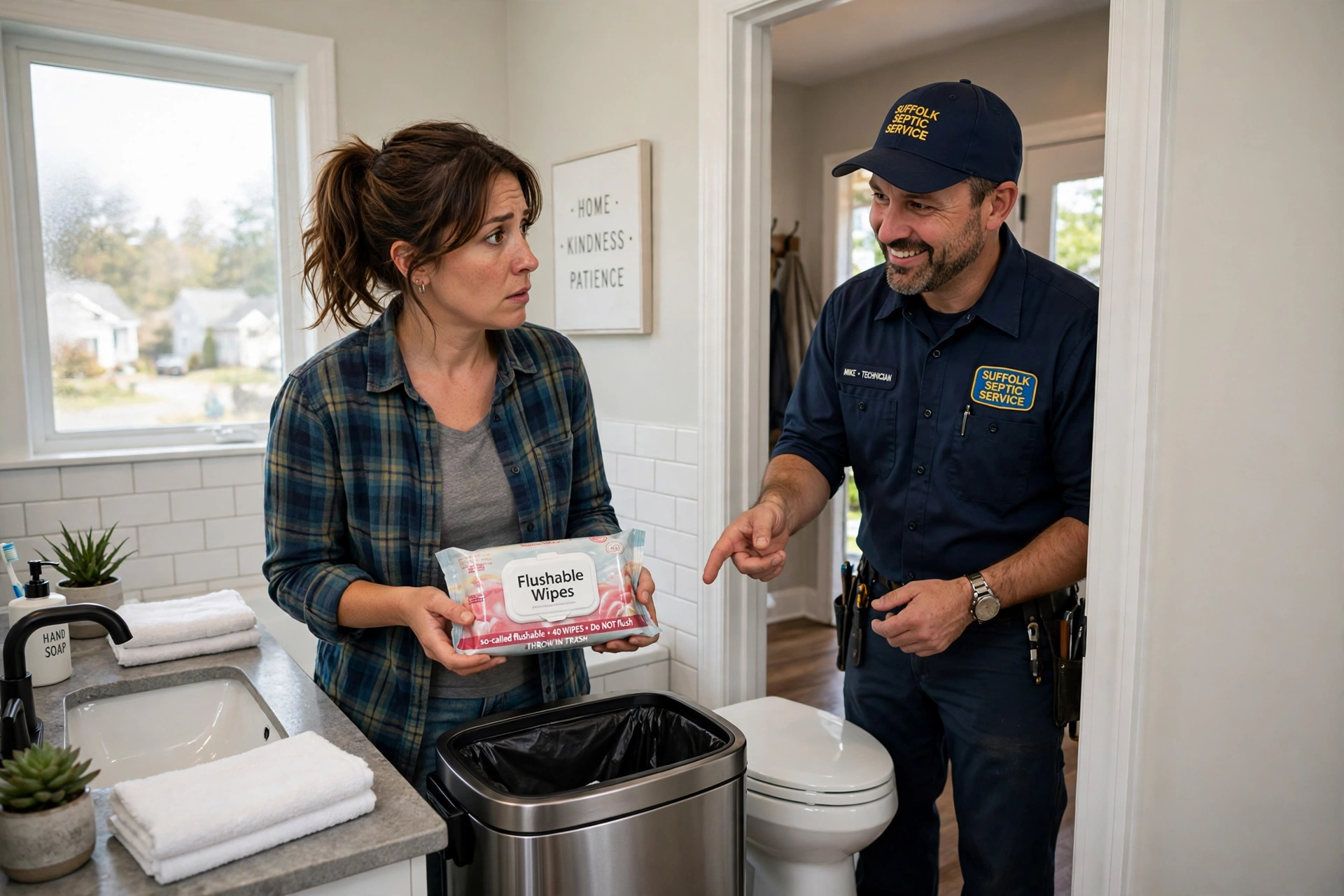
If it did not come out of you and it is not toilet paper, it does not belong in your toilet. That one sentence would prevent a large share of the septic backups in Suffolk County — and yet every week, local crews pull wipes, paper towels, grease, and worse out of tanks and cesspools in Coram, Riverhead, Mastic, and towns in between. Most of it was flushed by people who thought they were doing nothing wrong, often because the package told them it was fine.
Your system is not connected to a city sewer plant with industrial grinders. Everything you flush lands in a tank in your own yard, where it has to break down, settle, or be pumped out at your expense. Here is what to keep out, why it matters, and what to do instead.
Start with the 3P rule
Septic professionals use a simple test: only the three Ps should ever be flushed — pee, poop, and (toilet) paper. Toilet paper is engineered to fall apart within seconds in water. Almost everything else marketed as disposable, flushable, or biodegradable was designed for a municipal sewer, not for a tank and drain field on a Suffolk County lot. When in doubt, use the trash can. A small lidded can in every bathroom removes the temptation entirely.
1. “Flushable” wipes are the number one offender
This is the big one. Baby wipes, cleaning wipes, makeup wipes, and so-called flushable wipes do not break down like toilet paper. They can travel through your pipes, tangle in the tank, clog an effluent filter or pump, and form the stubborn mats technicians find at pumping time. Even wipes that clear your toilet can snag further along and start a blockage that backs sewage into the lowest drain in your house. The label may be legal, but in a septic system or an older cesspool there is no safe wipe to flush. Every wipe, every time, goes in the trash — no exceptions for guests, kids, or convenience.
2. The other paper products are not toilet paper
Paper towels, tissues, napkins, and shop towels feel like paper, so they seem harmless. They are made to hold together when wet — exactly the opposite of what your tank needs. Cotton balls, cotton swabs, dental floss, bandages, and cigarette butts also belong in the trash. Floss deserves a special warning: it is essentially thin plastic string, it never breaks down, and it wraps around pump parts and tangles other debris into a net. Feminine hygiene products, diapers, and cat litter — including litter labeled flushable — should never be flushed either. They absorb water, expand or settle as solids, and fill your tank far faster than normal use.
3. In the kitchen: grease, grounds, and the garbage disposal trap
What goes down the kitchen sink reaches the same tank. Cooking grease, oil, and fat may pour as a liquid, but they cool, harden, and coat pipes and tank walls, trapping other solids as they go. Wipe greasy pans with a paper towel into the trash, pour used oil into a sealed container for disposal, and scrape plates before washing. Coffee grounds do not break down either; they settle as grit in the bottom of the tank. Compost them or trash them. And if you have a garbage disposal, use it sparingly on a septic system. Ground food is still solid waste your bacteria must process, and heavy disposal use can shorten the time between pumpings. Many Suffolk County homeowners with older cesspools do better scraping everything and skipping the disposal altogether. Our guide on how often to pump your septic tank explains how habits like these change your pumping schedule.
4. Chemicals, paint, and old medicine can kill the system itself
A septic tank works because living bacteria break down waste. Large doses of antibacterial cleaners, bleach, drain openers, solvents, paint, paint thinner, pesticides, and motor oil can kill that bacteria or pass straight through and contaminate groundwater — a serious concern in Suffolk County, where the aquifer below your yard is also the source of drinking water. Use normal household cleaners in normal amounts, choose septic-conscious products when you can, and never use a chemical drain opener on a slow drain; it rarely fixes the real problem and it makes the job more hazardous for the technician who does. Take paint, chemicals, and expired medicine to a Suffolk County household hazardous-waste drop-off or a pharmacy take-back program instead of the drain.
Already flushed the wrong things? Watch for these signs
One wipe will not ruin a healthy system, so do not panic — just change the habit today. Do pay attention if drains slow down across the house, toilets gurgle, you smell sewage inside or near the tank, or the grass over the drain field turns unusually lush or soggy. Those are the early warning signs of a failing or overloaded system, and catching them early is the difference between a pumping or a filter cleaning and a full backup. If a backup is already happening, stop running water, keep people and pets away from any overflow, and call a licensed local professional. Never open a tank yourself — the gases inside can be lethal.
Make it easy for the whole house to get it right
Habits beat lectures. Put a small trash can with a lid and a liner in every bathroom. Post a friendly note for guests — “Septic system: please, nothing but toilet paper in the toilet” — especially before holiday gatherings. Tell babysitters, house cleaners, and older kids the 3P rule directly, because most people genuinely do not know wipes are a problem. Keep grease containers under the kitchen sink so the right choice is also the easy choice. And skip the tank additives sold as a substitute for pumping; a healthy system does not need them, and none of them dissolve a wipe.
The bottom line
Protecting your system is mostly free: flush only the three Ps, trash every wipe and paper product that is not toilet paper, keep grease and grounds out of the sink, and send chemicals to hazardous-waste drop-off instead of down the drain. Do that, pump on schedule, and your tank, drain field, and wallet will all last longer — which matters even more if you may one day use Suffolk County’s septic grant programs to upgrade to a newer I/A system.
Not sure if something you flushed has already caused a problem? Suffolk Septic Solutions connects Suffolk County homeowners with independent local service providers for pumping, inspections, and repairs. Get local help → or call (631) 519-8552 — our Sona line answers 24/7.