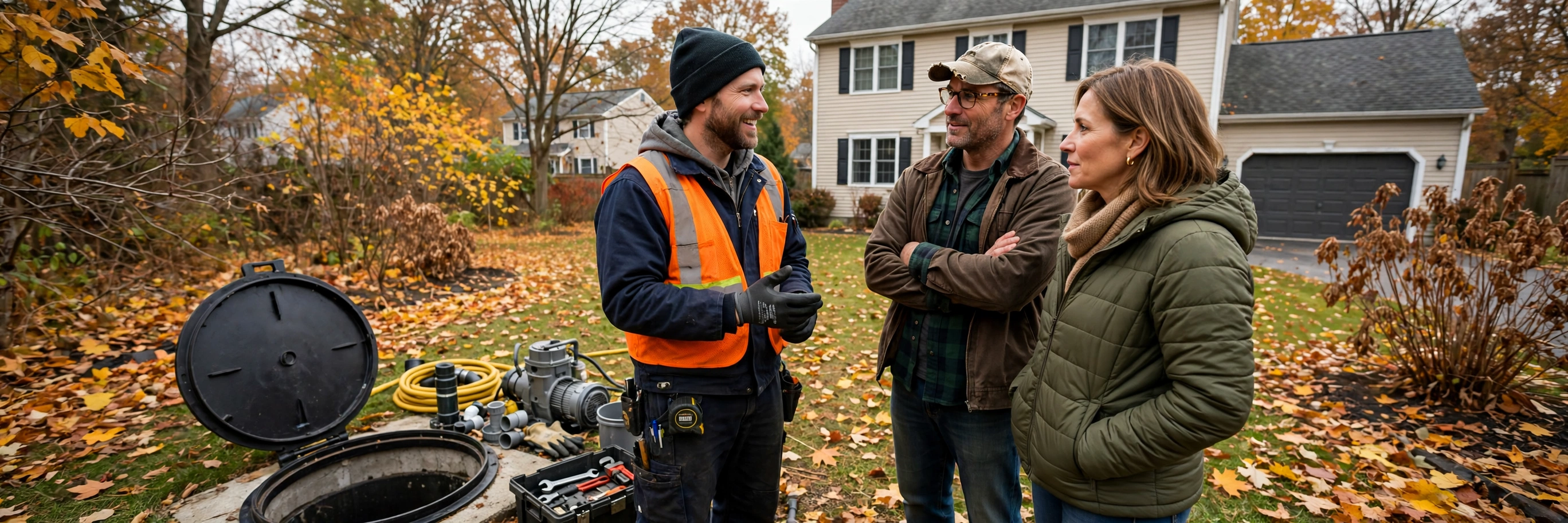
Winter on Long Island doesn’t ask permission. One week you’re raking leaves in Coram or Riverhead, the next a nor’easter is dropping wet snow and the overnight low is in the teens. Your septic system feels every bit of that swing — and winter is the worst possible time to discover a problem, because frozen ground turns a routine service visit into a difficult, expensive excavation. The good news: a few hours of preparation in late October and November will carry most Suffolk County systems safely through to spring.
Whether your home runs on a conventional system, an older cesspool, or a newer I/A treatment unit, this checklist covers what actually matters.
Why winter is hard on Suffolk County systems
Cold itself isn’t the main enemy — a buried tank full of active wastewater generates its own heat. The trouble is the combination around it: colder incoming water slows the bacteria that break down waste, shallow lines can freeze if water sits in them, and snowmelt saturates soil that’s already tight on the South Shore’s high-water-table lots. Then the holidays arrive with guests, extra laundry, and marathon cooking. A system that was “probably fine” in September can be overwhelmed by New Year’s.
1. Pump and inspect before the ground freezes
If your tank is anywhere near due, fall is the time to pump it — not February. A tank that enters winter near capacity has no buffer for holiday guests, and solids that escape into the drain field in cold, saturated soil do damage that can’t be undone in spring. While the technician is there, ask for a quick inspection: baffles, the effluent filter if you have one, and any early warning signs of failure like slow drainage or odors. Not sure where you stand on timing? Our guide on how often to pump your septic tank walks through the schedule by household size. If your lids are buried, fall is also the easiest time to locate and mark them — see step 3 — or to add a riser so winter access doesn’t mean digging through frozen soil.
2. Fix leaks and insulate what’s exposed
A running toilet or dripping faucet is an annoyance in summer; in winter it’s a freeze risk and a constant cold-water load on your tank. Walk the house now and fix any fixture that runs, drips, or fills slowly. Then check the plumbing that’s most exposed: pipes in unheated crawl spaces, garages, and additions. Foam pipe insulation is cheap, takes minutes to install, and protects the spots most likely to freeze. If your system has a pump chamber or an I/A unit with components near the surface, make sure covers are seated and intact — a cracked or missing lid lets cold air straight into the system.
3. Mark your system before the snow covers it
You can’t protect — or service — what you can’t find. Before the first snowfall, place a discreet marker stake at the tank lids and note the drain field’s boundaries. Sketch a simple map with measurements from two fixed points (a house corner and a fence post, for example) and keep it with your home records. If you need emergency service in January, that map saves the crew from probing a frozen, snow-covered yard, and it saves you from paying for the extra time. It also protects the system the rest of the year: anyone digging, planting, or parking on the property will know what to avoid.
4. Protect the drain field: snow is insulation, weight is the enemy
Here’s the counterintuitive part: a blanket of undisturbed snow over your drain field is good. Snow insulates the soil and helps keep the field from freezing deep. What hurts is compaction and traffic. Never drive or park vehicles over the tank or field — and that includes snowplows, delivery trucks, and the extra cars that show up for holiday parties. Don’t pile plowed snow on the field either; a dense plow pile melts into exactly the wrong spot in spring. Keep roof drains, sump pumps, and driveway runoff directed away from the field, and let grass grow a little longer into fall — that extra cover insulates too. If you’re planning fall yard work, keep heavy equipment off the system area entirely.
5. Spread out the holiday water load
Thanksgiving through New Year’s is peak season for backups, and it’s rarely the turkey’s fault — it’s the volume. Guests mean more showers, more laundry, more dishwasher cycles, all hitting a system whose soil is cold and slow to absorb. Space laundry across several days instead of running five loads on Saturday. Stagger showers on busy mornings. Scrape plates into the trash rather than leaning on a garbage disposal, which adds solids your tank doesn’t need heading into winter. None of this requires heroics — just avoiding the single-day surge that pushes a marginal system over the edge.
6. Leaving for the winter? Snowbird rules
Plenty of Suffolk County homeowners head south for part of the winter. A vacant house needs a plan, because an idle system with water sitting in shallow lines is the classic freeze scenario. Have the tank pumped before you leave if it’s close to due, and arrange for a neighbor to run water briefly on a regular schedule — a small flow of warm water keeps lines and the tank active. Keep the heat in the mid-50s, and make sure someone local has your service provider’s number and knows where the system is. A freeze discovered in hours is a repair; one discovered in March can be a disaster.
If something freezes or backs up mid-winter
Even a well-prepared system can have a bad week. If drains slow across the house, you smell sewage, or the lowest fixtures start to back up, cut water use immediately and call a licensed local professional — do not pour hot water, chemicals, or antifreeze into the system, and never open a tank yourself. Many winter problems turn out to be a frozen line or a single failed component rather than a dead system, and a prompt diagnosis is the difference between a repair bill and a replacement conversation. If a replacement ever is on the table, Suffolk County’s septic grant programs can offset a large share of the cost of upgrading to an I/A system — worth knowing before you need it, not after.
The bottom line
Winter-proofing a septic system isn’t a project — it’s a checklist: pump and inspect while the ground is still workable, fix the small leaks, mark the system, keep weight and extra water off the drain field, and pace the holiday load. Do those things in the next few weeks and your system should do what it’s supposed to do all winter: disappear.
Want a hand with your fall septic checklist? Suffolk Septic Solutions connects Suffolk County homeowners with independent local service providers for pumping, inspections, and repairs. Get local help → or call (631) 519-8552 — our Sona line answers 24/7, even on the coldest nights.