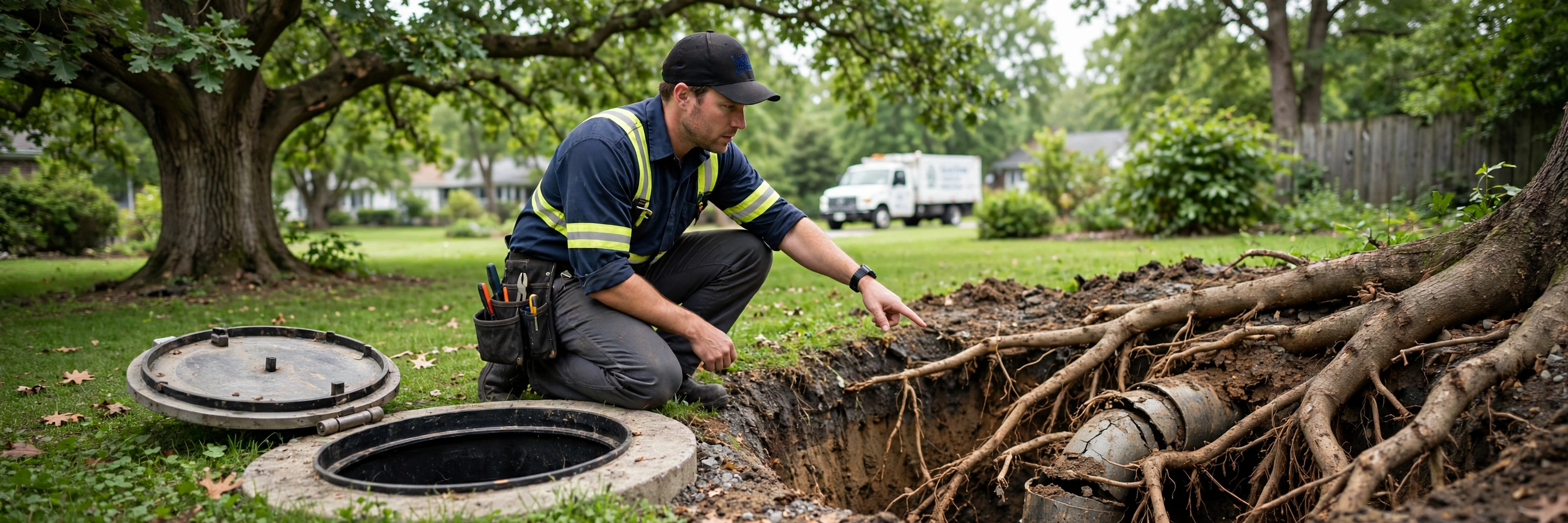
That big oak or maple shading your backyard is doing your septic system no favors. Tree roots are one of the most common — and most misunderstood — causes of slow drains, recurring clogs, and sudden backups in Suffolk County, especially in older neighborhoods where mature trees and aging cesspools or clay and concrete pipes have grown old together. Roots do not break into a healthy, sealed pipe overnight. They find a tiny opening, follow the water inside, and quietly build a net that catches everything you flush. By the time drains slow down, the tangle inside the line can be several feet long.
Why roots go after your septic lines
Roots grow toward what a tree needs: water, nutrients, and oxygen. A septic line offers all three. Even a sound pipe releases a trace of moisture vapor at its joints, and a pipe with a hairline crack, a shifted joint, or a loose tank connection leaks just enough to advertise itself underground. A fine root hair slips in — thinner than a thread — and once it reaches the steady flow inside, it thickens, branches, and sends out a feeler mat. Inside a cesspool, roots can work through joints between concrete rings or blocks and grow down into the liquid itself.
Suffolk County makes this more likely, not less. Many homes in places like Coram, Riverhead, Mastic, and the older North Shore villages were built decades ago with cesspools or early septic tanks, short pipe runs, and trees planted close to the house for shade. Those trees are now at full size, with root zones that can spread well beyond the canopy. Sandy Long Island soil lets roots travel easily, and willows, silver maples, and poplars are especially aggressive water-seekers — but a healthy oak can do the same damage, just more slowly.
The signs roots are already in the line
Root problems rarely announce themselves with one dramatic failure. They build. Watch for these patterns:
- Drains that slow down again weeks after clearing. Snaking helps for a while, then the same tub or toilet slows again — classic regrowth.
- Gurgling sounds from toilets or drains, especially when another fixture is running.
- More than one fixture backing up at once, which points to the main line rather than a single drain.
- A patch of grass that is suddenly greener, taller, or soggier in a line over the pipe or around the tank or cesspool.
- Sewage odor outdoors near the tank, or a shallow dip or sinkhole forming as soil washes into a damaged joint.
Some of these overlap with a full tank or a failing system, so do not guess on symptoms alone. Compare what you are seeing with our guide to the warning signs your septic system is failing — and remember that a system that is simply due for pumping can look root-clogged, and a root-clogged line can make a healthy tank look full.
Where roots usually get in
In most Suffolk County jobs, the entry point is predictable: the joints where the house line meets the tank, the tank inlet and outlet baffles, the seams of an older concrete tank, the distribution box, or the block or ring joints of a cesspool. A camera inspection is what turns suspicion into a plan. A technician feeds a small camera through the line and can show you exactly where roots are entering, how much of the pipe they fill, and — just as important — whether the pipe itself is cracked, offset, or collapsing. Without that picture, you are paying for clearing without fixing the opening the roots used, which means they will use it again.
What actually fixes a root problem
Mechanical cutting or hydro-jetting clears the line. A cutting head or high-pressure jet removes the root mass so flow returns — this is the right first step when you have a backup, but on its own it is a haircut, not a cure. Roots regrow from the entry point, often faster and thicker, the way a pruned shrub does.
Repairing or replacing the damaged section is the cure. Sealing a joint, replacing a cracked length of pipe with modern sealed pipe, repairing a tank connection, or replacing a deteriorated cesspool removes the opening. If a camera shows damage in several places, replacing the run is usually cheaper over five years than clearing it every year.
Chemical root treatments have a limited, supporting role. Some products can slow regrowth in a line that is otherwise sound, when used exactly as directed. They are not a substitute for pumping, they do not repair a cracked pipe, and they should never be dumped into a system blindly — ask the technician who saw your camera footage whether one makes sense for your system, and what it will and will not do. Be skeptical of any additive sold as a permanent fix.
If the root damage is part of a larger failure — a crumbling cesspool, a tank at the end of its life — get the replacement conversation started early and check the help available first. Our Suffolk County septic grant guide explains the county and state programs that can cover a significant share of an approved nitrogen-reducing I/A system for eligible homeowners.
How to keep roots out for good
Know where everything is. If you do not have a map of your tank, lines, and drain field or cesspool, ask for one at your next service visit and keep it. You cannot protect what you cannot locate — and neither can a landscaper.
Plant with distance. Keep new trees and large shrubs well away from the tank, lines, and drain field — at least 10 to 20 feet for smaller plantings, and considerably more for large shade trees and water-loving species. Plant grass, not gardens or trees, over the drain field.
Stay on your pumping and inspection schedule. Regular service is when small root intrusions and loose joints get caught while they are still cheap. See how often you should pump your septic tank for the right interval for your household, and expect to pay in the range covered in our Suffolk County pumping cost guide when you book it.
Act on the first repeat clog. One slow drain is a nuisance. The same slow drain returning a month after clearing is information — get a camera in the line before a full backup makes the decision for you, on a weekend, at emergency prices. Our septic maintenance checklist is a good once-a-year walk-through.
The bottom line
Roots are not a verdict on your system — they are a sign that a small opening underground has been found by a tree doing exactly what trees do. Clear the line, find the entry point on camera, seal or replace that section, and then plant and maintain with the system in mind. Handled that way, a root problem is a repair. Ignored, it becomes a backup, a damaged pipe, and eventually a replacement years before its time.
Think roots might be in your lines? Suffolk Septic Solutions connects Suffolk County homeowners with independent local service providers for inspections, pumping, and repairs. Get local help → or call (631) 519-8552 — our Sona line answers 24/7.